What if the greatest strength in a relationship is found in honoring what makes us different?
Sometimes an object catches my attention because of its beauty. Other times, it’s the story it carries that makes me stop and look a little longer.
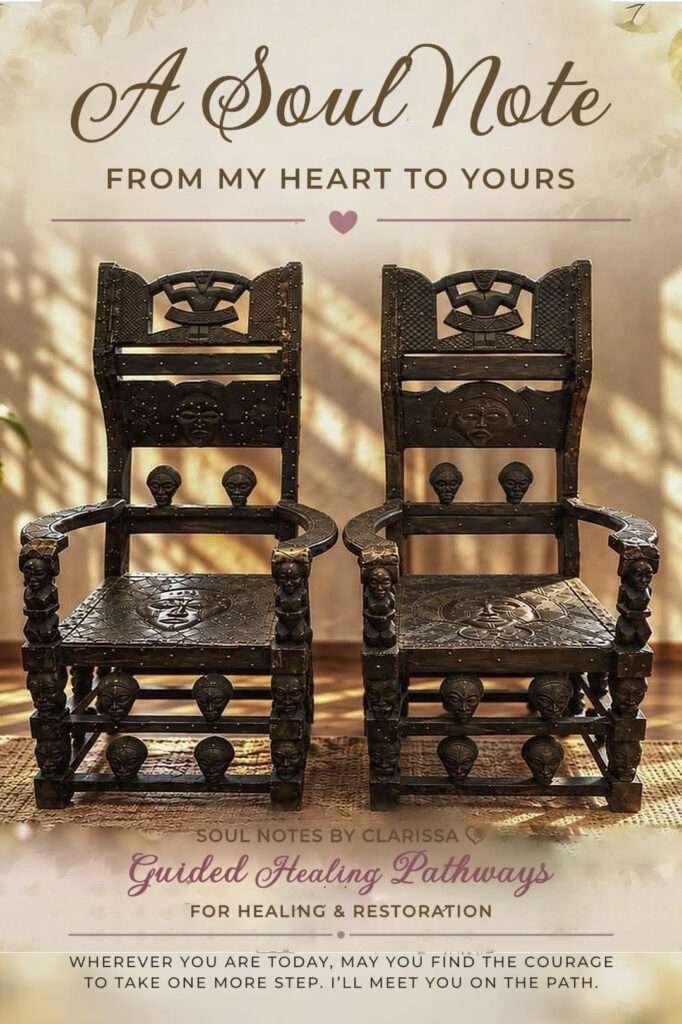
Along my travels, I came across these two remarkable antique chairs, standing side by side.
They were unlike anything I had seen before.
Made by the Chokwe people of Central Africa, they were described as a rare matched pair of ceremonial chairs, one representing the male and the other the female.
Their dark wooden surfaces were covered with intricate carvings, ancestral faces, and small brass tacks. Every detail seemed to hold a piece of history.
I learned that these chairs were symbols of prestige and authority, and that the carved ancestral figures represented the belief that leadership is supported by the wisdom and lineage of those who came before.
But what captured my imagination most was that they were a pair.
Two chairs.
Similar, yet distinctly different.
Each with its own character.
Each standing firmly in its own place.
And yet, somehow, they seemed to belong together.
As I stood looking at them, I began thinking about the relationships we create throughout our lives, especially the relationships between men and women.
For so long, societies have assigned different roles, expectations, and responsibilities to men and women.
Some of those traditions have offered a sense of belonging and shared purpose. Others have limited the freedom to express who we truly are.
And I began wondering…
What if we approached our relationships with a greater appreciation for the unique gifts each person brings?
What if we stopped measuring who gives more, who leads, who follows, or whose contribution matters most?
What if we simply recognized that love and partnership are not competitions?
I think about the many ways we support one another.
One person may offer courage when the other feels uncertain.
One may see possibilities where the other sees obstacles.
Sometimes one carries the weight while the other finds their footing.
And over time, those roles may reverse.
There are moments when we need to be strong for someone we love, and moments when we need to allow ourselves to be supported.
Perhaps that’s one of the most beautiful expressions of partnership.
The freedom to be fully ourselves while making room for another person to be fully themselves, too.
And then my thoughts returned to the ancestral faces carved into those chairs.
How much of what we believe about relationships has been handed down to us?
The ways we express love.
The expectations we carry.
The roles we learned by watching our parents, grandparents, and those who raised us.
Some of those lessons are beautiful gifts.
Others may be patterns we’re ready to change.
And isn’t that part of our own evolution?
We can honor those who came before us while choosing new ways of loving, listening, sharing responsibility, and understanding one another.
We can create relationships where differences are welcomed, perspectives are respected, and neither person has to diminish their light so the other can shine.
Where strength and tenderness belong to everyone.
Where leadership is shared.
Where love makes room for individuality.
Perhaps the beauty of standing together is that neither of us has to become less for the other to stand tall.
As I look at these photographs now, I find myself thinking about how two chairs, created generations ago, can still invite such a meaningful conversation today.
They remind me that relationships are something we continue to shape throughout our lives.
Through the love we offer.
The respect we practice.
The wisdom we share.
And the willingness to grow together while remaining true to ourselves.
Two chairs.
Two identities.
One beautiful reminder that there is room for both of us.
With love,
Clarissa