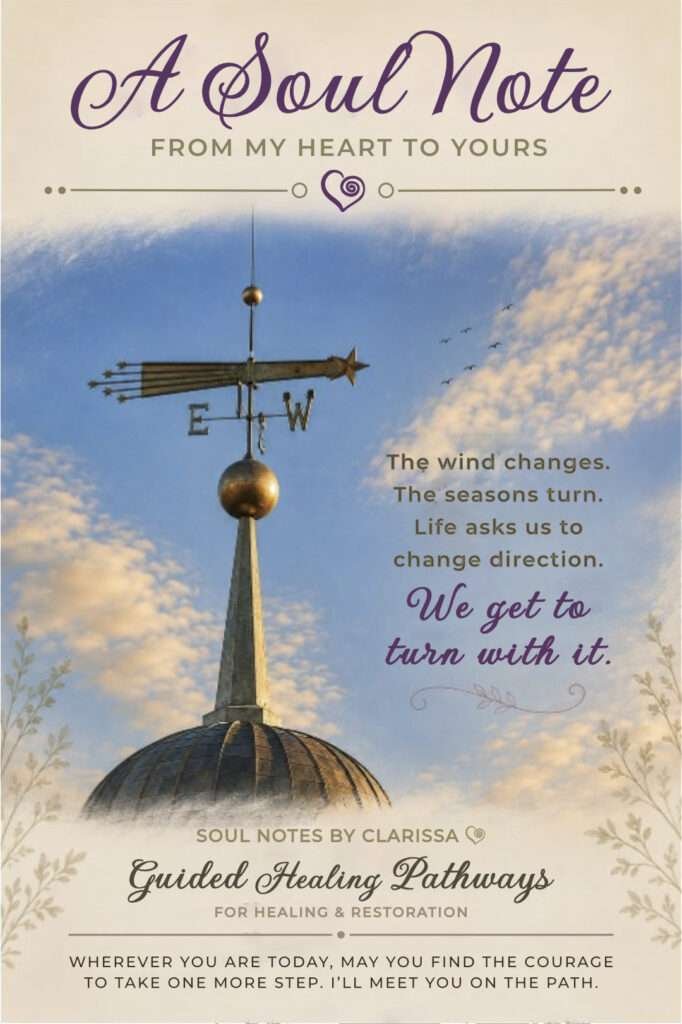
For centuries, people looked toward weathervanes for an answer to a very practical question:
Which way is the wind coming from?
Before weather apps and forecasts arrived in our pockets, the answer mattered.
Farmers watched the sky before planting and harvesting. Sailors studied the wind before leaving shore. Communities paid attention to nature because their lives moved in relationship with it.
And high above rooftops and steeples, the weathervane quietly turned.
I took this photograph because there was something about that old arrow suspended against such an enormous blue sky that held my attention.
Maybe it was the simplicity of it.
A weathervane doesn’t tell the wind where to go.
It doesn’t resist when the wind changes.
It turns, finds the direction from which the wind is coming, and points toward it.
I couldn’t help wondering how different that is from the way we sometimes move through our own lives.
We become attached to a direction.
A plan.
A timeline.
An idea of how something was supposed to unfold.
And then the wind changes.
Something we once wanted no longer fits.
A relationship changes.
Work changes.
Our priorities shift.
A dream evolves.
Or perhaps we simply wake one morning and realize that the person who made the original plan isn’t quite the person standing here anymore.
Yet changing direction can feel strangely uncomfortable.
We wonder what people will think.
We worry that changing our minds means we were wrong.
We convince ourselves that because we’ve already traveled this far, we should keep going.
But nature has never required such explanations.
The wind changes because the wind changes.
Seasons turn.
Trees bend.
Birds alter their course.
Even rivers find another way around what they cannot pass through.
Maybe there is wisdom in being responsive rather than rigid.
A weathervane can turn completely around and still remain firmly rooted to the same place.
I love that.
Because perhaps changing direction doesn’t always mean we’ve lost our way.
Sometimes it means we’ve finally noticed what is happening around us.
And sometimes what changes isn’t the world around us at all.
It’s us.
Our experiences teach us.
Our hearts become clearer.
We discover something we couldn’t have known five years ago—or even five months ago.
There should be room in a human life for that.
Room to reconsider.
Room to listen.
Room to say, this mattered to me once, but something different is calling me now.
You can change direction without losing your place in the world.
Perhaps the question isn’t whether the winds of life will change.
They will.
Perhaps the better question is whether we can become quiet enough to notice when they do—and trust ourselves enough to turn toward what comes next.
With love,
Clarissa